
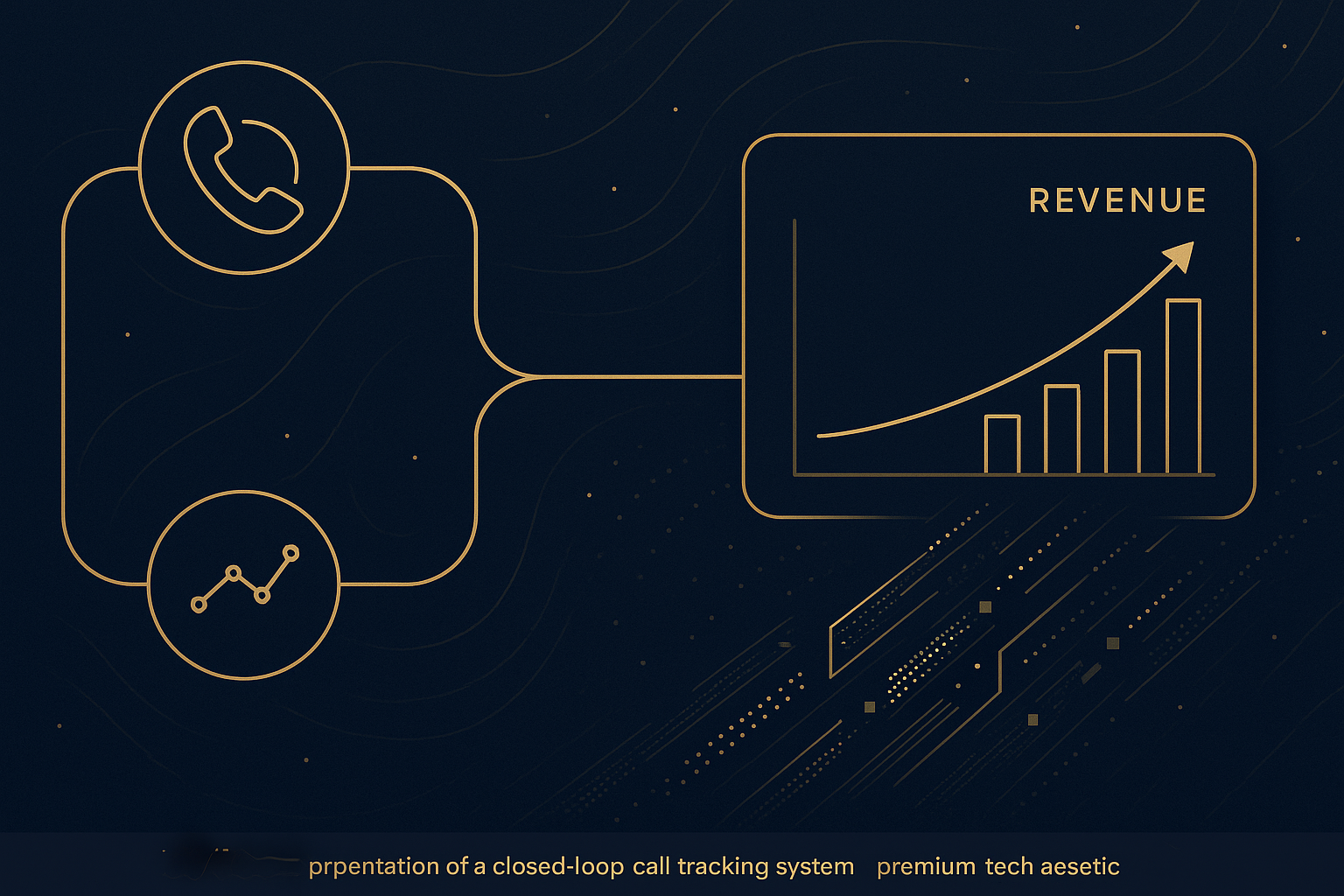
The Call Loop: Turning inbound calls into booked revenue is the most overlooked conversion infrastructure in performance marketing. Most businesses track form fills and chat leads with precision, then let phone calls disappear into a black box where attribution dies and revenue leaks. A closed call loop solves this by capturing every inbound call, attributing it to the correct marketing source, recording the conversation, scoring conversion quality, and tying the lead directly to booked revenue in your CRM. For businesses in Sarasota, Bradenton, Lakewood Ranch, Venice, and nationwide markets where phone calls drive real revenue, building a call loop is not optional anymore.
Quick Answer: The call loop is a closed-loop system that tracks inbound phone calls from first ring through booked revenue, connecting call source attribution, conversation recording, lead scoring, and CRM integration into one measurable pipeline. Most businesses lose 40 to 60 percent of their marketing attribution because they cannot tie phone calls back to the campaigns that generated them. A properly built call loop captures call source, conversation outcome, appointment status, and revenue per lead, turning every inbound call into a trackable data point.
What Is the Call Loop and Why It Matters for Revenue
The call loop is a closed-loop tracking system that captures every data point from an inbound phone call and connects it to revenue outcomes. It starts when a prospect dials your business, continues through source attribution and conversation recording, extends into CRM lead capture, and closes when the lead converts into booked revenue. Unlike open-loop systems where calls simply ring and someone answers, a call loop treats every inbound call as a trackable event with a measurable ROI.
Phone calls remain the highest-intent conversion action for most service businesses. A prospect who picks up the phone is further down the funnel than someone who fills out a form. However, most businesses still treat phone calls as unmeasurable interactions. They know calls are coming in, but they cannot tell which Google ad, Meta campaign, organic search query, or referral source generated each call. Consequently, they make budget decisions blind, overspending on low-performing channels while underinvesting in the campaigns that drive actual phone leads.
A call loop solves this by assigning every inbound call to a marketing source. Call tracking numbers allow businesses to deploy unique phone numbers across different campaigns, landing pages, and channels. When a prospect calls, the system instantly logs which number they dialed, which ties back to the exact campaign, keyword, or referral source that triggered the call. This data flows into your CRM and attribution model, giving you a complete picture of which marketing activities generate real conversations with prospects.
Furthermore, the loop does not stop at attribution. Modern call tracking systems record every conversation, transcribe the audio, and use AI to score call quality. A scored call is not just a data point; it is a qualified lead with context. Your team knows whether the caller booked an appointment, asked for pricing, requested a callback, or hung up within ten seconds. This level of granularity transforms phone calls from unmeasurable interactions into structured data you can optimize against.
The 6 Core Components of a High-Performing Call Loop
1. Dynamic Call Tracking Numbers
Dynamic number insertion (DNI) is the technology that swaps phone numbers on your website based on the traffic source. DNI assigns unique phone numbers to different campaigns, channels, or even individual keywords, so when a visitor lands on your site from a Google ad and calls, the system logs that call as originating from that specific ad. A visitor from organic search sees a different number, and a visitor from a Meta ad sees yet another. The result is campaign-level attribution at the call level, which most businesses never achieve.
2. Source Attribution and UTM Integration
Source attribution connects inbound calls to the marketing campaigns that generated them. Most call tracking platforms integrate with Google Ads, Meta Ads, and analytics tools to pull UTM parameters and campaign tags. When a call comes in, the system matches the phone number to the traffic source, logs the campaign name, ad group, keyword, and referring URL, then pushes that data into your CRM. This integration allows your team to measure cost per call, conversion rate per source, and revenue per campaign with the same precision you apply to form fills.
3. Conversation Recording and Transcription
Recording every call creates an audit trail that improves both attribution and conversion optimization. Conversation recordings allow you to review how your team handles leads, identify objections prospects raise, and spot training gaps in your sales process. Additionally, modern call tracking platforms transcribe calls and use natural language processing to extract keywords, sentiment, and intent signals. A transcription that includes phrases like “ready to book” or “what are your prices” gets scored higher than a call that ends with “just looking around.”
4. AI-Powered Call Scoring and Qualification
AI call scoring automates lead qualification by analyzing conversation content, duration, and outcome. A high-scoring call is one where the prospect engaged meaningfully, expressed buying intent, and moved toward a decision. For example, a call that lasts eight minutes, includes questions about availability, and ends with a scheduled appointment scores higher than a fifteen-second misdial. AI scoring allows your CRM to prioritize leads automatically, route high-quality calls to senior reps, and surface revenue-generating conversations without manual review. Custom AI systems can be trained on your historical call data to recognize the verbal patterns and conversation structures that predict closed revenue.
5. CRM Integration and Lead Capture
CRM integration ensures that every inbound call becomes a structured lead record with full attribution context. When a call comes in, the system creates or updates a contact in your CRM, logs the call source, attaches the recording and transcript, tags the lead with a quality score, and triggers follow-up workflows. This integration closes the loop between marketing and sales. Your CRM now contains every lead, whether they came in via form, chat, or phone, with consistent data structure and attribution tagging. Sales teams can see which campaigns are sending them the best leads, and marketers can measure cost per booked appointment instead of cost per click.
6. Revenue Attribution and ROI Measurement
The final component is tying calls back to booked revenue. Most businesses stop tracking at the lead capture stage, but a true call loop follows the lead through the sales pipeline and attributes revenue to the original marketing source. When a phone lead converts into a paying customer, the CRM logs the deal value and ties it back to the call that started the relationship. This creates closed-loop attribution where you can measure revenue per campaign, lifetime value per source, and true marketing ROI. You are no longer measuring clicks or calls; you are measuring booked revenue per dollar spent.
How to Build a Call Loop That Drives Revenue (Not Just Rings)
Building a call loop requires integrating call tracking infrastructure with your CRM, analytics stack, and marketing platforms. Most businesses start by deploying a call tracking platform that supports dynamic number insertion and source attribution. The platform issues unique phone numbers for each campaign, swaps numbers dynamically on your website, and logs every inbound call with full source context.
Next, connect your call tracking platform to your CRM. This integration ensures that every call creates a lead record with attribution data attached. The CRM should log call duration, recording URL, transcript, quality score, and marketing source. Sales reps should be able to listen to recordings, review transcripts, and see which campaign generated each lead without leaving the CRM interface.
Then, layer on AI-powered call scoring. Train the system to recognize high-intent conversations by analyzing historical call data and tagging calls that led to booked appointments or closed deals. The AI learns which keywords, phrases, and conversation patterns predict revenue, then scores new calls automatically. High-scoring calls get routed to senior reps, added to priority follow-up lists, and flagged for immediate attention.
Finally, close the loop by connecting CRM deal data back to marketing attribution. When a phone lead converts into a customer, log the deal value and tie it to the original call source. This allows you to measure revenue per campaign, cost per acquisition, and lifetime value per channel with full call attribution included. According to the Federal Communications Commission, businesses must also comply with call recording and consent regulations, which vary by state and require proper disclosure in most jurisdictions.
Businesses in Sarasota, Bradenton, Lakewood Ranch, and Venice that implement closed call loops typically see attribution accuracy improve by 40 to 70 percent within the first 90 days. They stop guessing which campaigns drive phone leads and start reallocating budget toward the channels that generate actual appointments and revenue.
What to Expect: Call Loop Performance Benchmarks
A well-built call loop transforms phone calls from unmeasurable events into structured revenue data. However, performance varies based on industry, call volume, and sales process complexity. Most businesses should expect the following benchmarks within 60 to 90 days of implementation.
Call attribution accuracy should reach 85 to 95 percent, meaning the system correctly identifies the marketing source for nearly every inbound call. Misattributed calls typically result from visitors who interact with multiple channels before calling, which requires multi-touch attribution models to resolve. Dynamic number insertion eliminates most single-touch attribution errors by assigning unique numbers per source.
Call-to-appointment conversion rates vary by industry but generally range from 15 to 40 percent for qualified inbound calls. Service businesses with strong phone sales processes convert 30 to 50 percent of inbound calls into booked appointments. Lower conversion rates signal sales training gaps, weak scripts, or poor lead qualification upstream.
Revenue attribution completeness measures the percentage of closed deals that can be traced back to a specific marketing source. Most businesses start at 20 to 40 percent attribution completeness because they lack call tracking and rely only on form fills. A closed call loop pushes attribution completeness to 70 to 90 percent, capturing revenue from phone leads that previously disappeared into the attribution black box.
Cost per booked appointment (not cost per call) is the metric that matters. Cost per call measures marketing efficiency, but cost per booked appointment measures sales outcome. Businesses should expect cost per appointment to range from $50 to $300 depending on industry, market, and campaign type. High-intent Google search campaigns typically deliver lower cost per appointment than broad awareness campaigns, but both become measurable once the call loop is in place.
Common Call Loop Mistakes That Kill Revenue
Many businesses deploy call tracking but fail to build a true call loop because they stop at basic attribution. They log which campaigns generate calls but never connect those calls to booked appointments or revenue. As a result, they measure activity instead of outcomes. A call loop is not complete until every phone lead is followed through the sales pipeline and tied back to revenue.
Another common mistake is ignoring call quality. Not all calls are equal. A misdial, a spam call, and a high-intent prospect all count as “calls” in basic tracking systems. Without call scoring, your data is polluted with low-quality interactions that skew cost per lead and conversion metrics. AI-powered call scoring filters out junk and surfaces the conversations that matter.
Businesses also underestimate the importance of CRM integration. If call data lives in a separate platform and never flows into the CRM, your sales team cannot act on it, and your attribution model remains incomplete. The call tracking system and CRM must be tightly integrated, with automatic lead creation, real-time data sync, and bidirectional updates.
Finally, many businesses fail to train their sales teams to handle inbound calls effectively. A call loop exposes weak phone sales performance because every conversation is recorded and scored. If your team is not trained to qualify leads, handle objections, and book appointments on the first call, your conversion rate will remain low no matter how good your tracking infrastructure is. Call recording and coaching are not optional; they are core components of a high-performing call loop.
How Much Does It Cost to Build a Call Loop?
Call loop infrastructure costs vary based on call volume, platform features, and integration complexity. Most businesses should budget $200 to $800 per month for call tracking software, depending on the number of tracking lines, recording storage, and AI scoring features. Entry-level platforms start at $50 to $150 per month but lack advanced attribution, AI scoring, and robust CRM integrations.
CRM integration and setup typically cost $1,000 to $5,000 as a one-time implementation fee, depending on whether you need custom API work, data migration, or multi-platform attribution mapping. Businesses with complex sales processes or multiple CRMs should expect higher integration costs.
AI call scoring and transcription add $100 to $400 per month depending on call volume and the level of automation required. Basic transcription is cheap, but training custom AI models to recognize industry-specific intent signals and score calls accurately requires more investment upfront.
Ongoing management and optimization require 5 to 15 hours per month for most businesses. This includes reviewing call recordings, refining scoring models, adjusting attribution rules, and training sales teams based on call performance data. Businesses that lack in-house expertise often outsource call loop management to growth teams that specialize in attribution and revenue operations.
Total cost of ownership for a fully integrated call loop ranges from $500 to $2,000 per month for most small to midsize businesses. Larger enterprises with high call volumes and complex attribution models may spend $3,000 to $10,000 per month. However, the ROI is clear: businesses that implement call loops typically recover the investment within 30 to 60 days by eliminating wasted ad spend on low-performing campaigns and reallocating budget to channels that drive real appointments and revenue.
Frequently Asked Questions About The Call Loop: Turning Inbound Calls Into Revenue
What is the call loop in performance marketing?
The call loop is a closed-loop tracking system that connects inbound phone calls to marketing sources, conversation outcomes, CRM lead records, and booked revenue. The loop starts when a prospect dials your business and closes when the lead converts into a paying customer with full attribution data logged. A complete call loop includes dynamic call tracking, source attribution, conversation recording, AI scoring, CRM integration, and revenue reporting.
How does call tracking work for businesses in Sarasota and Bradenton?
Call tracking assigns unique phone numbers to different marketing campaigns, landing pages, or traffic sources. When a prospect in Sarasota, Bradenton, or Lakewood Ranch calls, the system logs which number they dialed and ties the call back to the campaign that generated it. Dynamic number insertion swaps phone numbers on your website based on the visitor’s traffic source, ensuring accurate attribution at the campaign level.
How much does call tracking software cost?
Call tracking software costs $50 to $800 per month depending on the number of tracking lines, call volume, recording storage, and advanced features like AI scoring and CRM integration. Entry-level platforms start at $50 per month but lack robust attribution and automation. Full-featured platforms with AI call scoring, dynamic number insertion, and multi-platform integrations typically cost $200 to $500 per month for small to midsize businesses.
What is dynamic number insertion (DNI)?
Dynamic number insertion is a technology that swaps phone numbers on your website based on the visitor’s traffic source. DNI allows you to display different phone numbers to visitors from Google Ads, Meta campaigns, organic search, or direct traffic. When a visitor calls, the system logs which number they dialed and attributes the call to the correct marketing campaign. Dynamic number insertion is essential for accurate campaign-level attribution.
How do you measure revenue per call?
Revenue per call is measured by connecting call tracking data to CRM deal records. When a phone lead converts into a paying customer, the CRM logs the deal value and ties it back to the original inbound call and marketing source. Revenue per call is calculated by dividing total revenue from phone leads by the number of inbound calls. This metric allows businesses in Venice and nationwide markets to measure true marketing ROI, not just cost per lead.
What is AI call scoring?
AI call scoring is an automated process that analyzes conversation content, duration, sentiment, and outcome to assign a quality score to each inbound call. AI models are trained on historical call data to recognize patterns that predict booked appointments and closed revenue. High-scoring calls include keywords like “ready to book,” long conversation durations, and positive sentiment. AI call scoring allows sales teams to prioritize high-intent leads automatically without manually reviewing every call recording.
How do you integrate call tracking with a CRM?
Call tracking integrates with CRMs through API connections that automatically create or update lead records when calls come in. The integration pushes call duration, recording URL, transcript, source attribution, and quality score into the CRM as structured data fields. Most modern CRMs support native integrations with call tracking platforms, and custom API work is required for complex multi-platform setups. Proper integration ensures every phone lead is captured with full attribution context.
Why do most businesses lose attribution on phone calls?
Most businesses lose attribution on phone calls because they display a single static phone number on their website and cannot differentiate which marketing campaigns generated each call. Without dynamic number insertion or call tracking, all inbound calls appear identical with no source data attached. This creates an attribution black box where 40 to 60 percent of leads disappear from marketing reports. Businesses then make budget decisions based on incomplete data, overspending on measurable channels like form fills while underinvesting in phone-driven campaigns.
How long does it take to implement a call loop?
Implementing a call loop typically takes 2 to 6 weeks depending on the complexity of your marketing stack, CRM setup, and the number of campaigns requiring unique tracking numbers. Basic call tracking with dynamic number insertion can be deployed in 1 to 2 weeks. Full CRM integration, AI call scoring configuration, and revenue attribution mapping usually require 4 to 6 weeks. Businesses should plan for an additional 30 days of optimization and data validation before call loop performance stabilizes.
What is the difference between call tracking and a call loop?
Call tracking logs inbound calls and attributes them to marketing sources, but it does not close the loop by connecting calls to revenue outcomes. A call loop includes call tracking as one component, then extends through conversation recording, lead qualification, CRM integration, and revenue attribution. Call tracking measures activity; a call loop measures revenue. Most businesses use call tracking but fail to build a complete loop, which leaves attribution incomplete and prevents true ROI measurement.
Market Tap: Build a Call Loop That Ties Calls to Revenue
Market Tap builds closed-loop call tracking and attribution systems that connect inbound calls to booked revenue. We deploy dynamic call tracking, integrate call data with your CRM, implement AI-powered call scoring, and map revenue back to the campaigns that drive phone leads. Our systems are built for service businesses in Sarasota, Bradenton, Lakewood Ranch, Venice, and nationwide markets where phone calls represent real pipeline and revenue. We do not just track calls; we build infrastructure that turns every inbound ring into measurable, optimizable, revenue-generating data. If your business relies on phone leads and you cannot tie calls back to campaigns, your attribution is broken. Let’s fix it.