
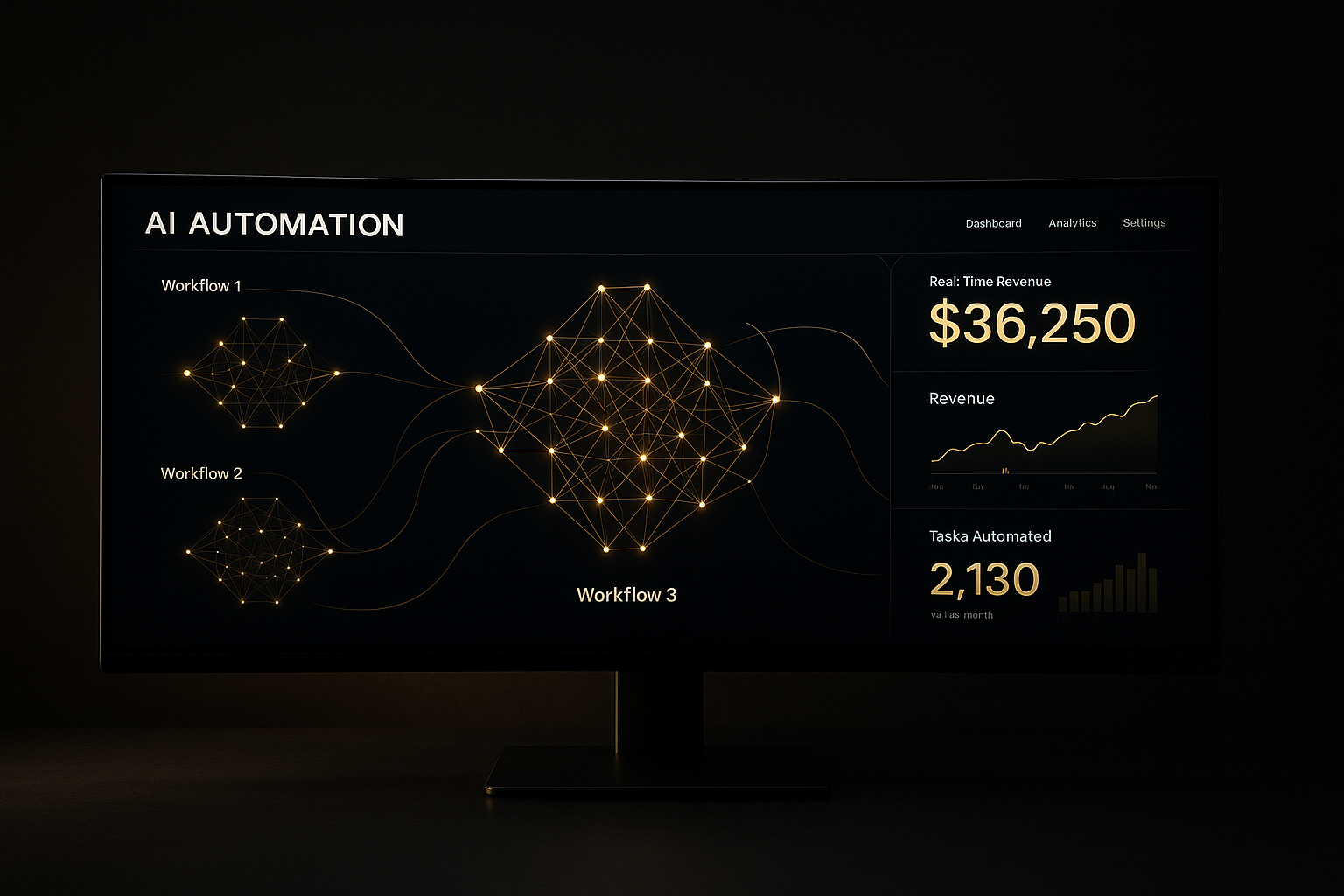
Custom AI systems are purpose-built artificial intelligence solutions designed specifically for your business operations, revenue processes, and growth infrastructure. Unlike off-the-shelf software, these systems integrate directly with your data sources, learn from your specific customer patterns, and automate decisions that drive measurable outcomes. For growth teams in Sarasota, Bradenton, Lakewood Ranch, Venice, and nationwide, custom AI represents the difference between generic automation and intelligence that compounds revenue over time.
Quick Answer: Custom AI systems are tailored artificial intelligence solutions built to solve specific business problems by connecting your data sources, automating revenue-critical decisions, and learning from your unique customer patterns. They differ from standard software by adapting to your exact workflows, integrating with existing infrastructure, and optimizing for the metrics that matter to your business. Most implementations focus on lead qualification, attribution modeling, customer lifecycle prediction, or operational automation.
What Are Custom AI Systems and Why They Matter Now
Off-the-shelf platforms optimize for average use cases across thousands of customers. However, your revenue model, customer acquisition process, and operational constraints are not average. Custom AI systems are machine learning models, automation frameworks, and intelligent decision engines built around your specific data architecture and business logic.
The shift matters because traditional marketing and sales technology treats every business like a template. Furthermore, generic AI tools like ChatGPT provide broad capabilities but lack context about your customer behavior, your attribution model, or your profitability thresholds. A custom system knows that a lead from Lakewood Ranch converts at 34% while a lead from organic search in Venice converts at 18%. It knows your customer lifetime value curve, your seasonal patterns, and which combinations of touchpoints predict closed revenue.
Therefore, companies measuring booked revenue rather than vanity metrics need infrastructure that understands their specific definition of success. Custom AI systems provide that specificity. They monitor the exact signals your business generates, apply intelligence to the decisions your team makes repeatedly, and optimize for outcomes you actually care about.
Additionally, as AI visibility becomes critical for discovery, having systems that understand how your business should be represented in AI search results creates competitive advantage. The companies building custom intelligence infrastructure today will dominate search and discovery tomorrow.
5 Core Components Every Custom AI System Needs
1. Unified Data Layer
A unified data layer is the foundational infrastructure that aggregates information from all business systems into a single, queryable source of truth. This layer connects your CRM, advertising platforms, call tracking system, website analytics, and revenue database so the AI can see complete customer journeys rather than fragmented touchpoints.
Most businesses have data trapped in silos. For example, your Google Ads account knows about clicks, your CRM knows about pipeline, and your accounting system knows about closed revenue. However, none of these systems talk to each other in real time. Consequently, you cannot train an AI model to predict which ad spend drives actual revenue because the data never connects.
Building the unified layer requires API integrations, data transformation pipelines, and schema mapping. Moreover, the layer must handle identity resolution so the AI knows that the person who clicked an ad, filled out a form, and booked a call is the same individual. Without this foundation, your custom AI system operates on incomplete information and produces unreliable predictions.
2. Revenue Attribution Model
Revenue attribution modeling is the methodology that assigns credit to marketing touchpoints based on their actual influence on closed deals. Custom AI systems use attribution models to understand which channels, campaigns, messages, and timing combinations drive conversions worth optimizing.
Standard attribution models like last-click or first-click oversimplify reality. In contrast, custom AI builds probabilistic models based on your specific customer journey data. For instance, if your business in Bradenton typically sees five touchpoints before conversion, the AI learns which sequences predict the highest-value customers and adjusts budget allocation accordingly.
The model must connect ad spend to booked revenue, not just to leads or clicks. Therefore, it requires integration between your marketing platforms and your financial systems. Additionally, the model should account for time lag, understanding that a touchpoint today might influence revenue 60 days from now. This temporal complexity is exactly where custom systems outperform generic tools.
3. Predictive Scoring Engine
A predictive scoring engine analyzes historical patterns to assign probability scores to leads, opportunities, or customer actions before they happen. This component answers questions like “Which leads will close?” and “Which customers will churn?” so your team focuses resources on the highest-value activities.
For example, a custom scoring engine might analyze 200 data points about a new lead (source channel, time on site, pages viewed, geographic location, company size, engagement velocity) and output a score from 0 to 100 indicating likelihood to close. In fact, businesses using predictive scoring typically see 20% to 40% increases in conversion rates because sales teams prioritize correctly.
The engine improves over time. As more leads move through your funnel and either convert or don’t, the AI refines its understanding of which patterns matter. Similarly, the model can identify emerging patterns that humans miss. Perhaps leads who view your pricing page three times but never request a demo actually convert at higher rates than leads who book immediately. The AI surfaces these insights automatically.
4. Automated Decision Framework
An automated decision framework is the ruleset and logic layer that takes AI predictions and executes actions without human intervention. This framework moves your business from insight to outcome by automatically routing leads, adjusting bids, triggering messages, or flagging anomalies.
Consider lead routing. Instead of round-robin assignment, a custom AI system routes each lead to the rep most likely to close it based on historical performance, current workload, geographic expertise, and lead characteristics. Consequently, your close rate increases because matching is optimized rather than randomized.
On the other hand, the framework also handles bid management for paid media. If the AI predicts that leads from a specific audience segment in Sarasota will generate 30% higher lifetime value, it automatically increases bids for that segment while decreasing spend on lower-value audiences. This happens in real time, adjusting to performance shifts faster than any human could.
The decision framework must include guardrails. Therefore, you define boundaries (never spend more than X per day, never route more than Y leads to a single rep) so the AI operates within acceptable risk parameters.
5. Continuous Learning Loop
A continuous learning loop is the feedback mechanism that measures outcomes, compares them to predictions, and retrains models based on new data. This component ensures your custom AI system improves over time rather than becoming outdated.
The loop works like this: The AI makes a prediction (this lead will close with 78% probability). Then, reality unfolds (the lead does or doesn’t close). Next, the system calculates prediction error and adjusts the model. Finally, the updated model makes better predictions on the next batch of leads.
Moreover, the learning loop must account for concept drift. Concept drift occurs when the patterns that predict success change over time due to market conditions, competitive dynamics, or business model evolution. For instance, if you launch a new service line, the historical data about what makes a good lead becomes less relevant. The learning loop detects this shift and adapts.
The Architecture of Scale: Why Modern Growth Requires Systems, Not Campaigns explains why continuous improvement infrastructure matters more than one-time optimizations. Custom AI systems embody this philosophy by treating every interaction as a learning opportunity.
What Problems Do Custom AI Systems Solve Best?
Custom AI systems excel at problems with four characteristics: high volume, complex patterns, measurable outcomes, and sufficient historical data. These systems transform operational bottlenecks into automated advantages when applied correctly.
First, lead qualification becomes faster and more accurate. Instead of sales reps manually reviewing every inbound inquiry, the AI scores and routes automatically. For example, a med spa in Lakewood Ranch might receive 300 inquiries per month. A custom system instantly identifies the 40 most likely to book high-value treatments and prioritizes those for immediate follow-up.
Second, attribution modeling reveals true ROI across channels. Most businesses know their total ad spend and total revenue but cannot connect the two with confidence. A custom AI system tracks every touchpoint, builds multi-touch attribution models, and shows which combinations drive the highest-margin customers. Consequently, you shift budget toward what actually works rather than what looks good in a platform dashboard.
Third, customer lifecycle prediction reduces churn and maximizes lifetime value. The AI identifies early warning signals that a customer is likely to churn, triggering retention campaigns before it’s too late. Similarly, it predicts which customers are ready for upsells and when, increasing expansion revenue.
Fourth, operational automation eliminates repetitive decision-making. Tasks like bid adjustments, creative rotation, audience expansion, and budget reallocation happen automatically based on real-time performance data. Therefore, your team focuses on strategy and creative rather than manual optimization.
Additionally, custom AI systems handle anomaly detection, identifying sudden changes in conversion rates, cost per acquisition, or lead quality that indicate technical issues or market shifts. This early warning system prevents small problems from becoming expensive mistakes.
How Do Custom AI Systems Differ From Standard Marketing Tools?
Standard marketing tools provide pre-built features designed for broad audiences. Custom AI systems, in contrast, are built specifically for your data, your processes, and your definition of success. The distinction matters because generic tools optimize for generic goals.
For instance, Google Ads optimizes for conversions as you define them, but it treats all conversions equally. If you tell Google that a form submission is a conversion, it will drive more form submissions. However, not all form submissions are equally valuable. A custom AI system knows that form submissions from certain sources, at certain times, with certain engagement patterns convert to revenue at 4X the rate of others. It optimizes for revenue, not just conversions.
Moreover, standard tools operate within their own data silos. Facebook doesn’t know what happens after someone clicks your ad unless you feed conversion data back. Even then, it only sees aggregate numbers. A custom AI system sees the complete journey: which Facebook ad led to which landing page visit, which retargeting sequence, which sales call, which objections, and which contract value. Therefore, it understands causation rather than just correlation.
Additionally, pre-built tools cannot incorporate your proprietary business logic. Perhaps you know that customers who ask about financing options during their first call close at 60% while those who don’t ask close at 20%. Your custom AI system can factor this behavioral signal into lead scoring and routing. Standard tools cannot access or use this insight.
Finally, custom systems learn from your specific outcomes rather than aggregated data from millions of users. According to research from the National Institute of Standards and Technology, AI models trained on domain-specific data outperform general-purpose models by 30% to 60% on specialized tasks. Your custom system gets smarter as your business generates more data, creating a compounding advantage.
How Much Do Custom AI Systems Cost and What Should You Expect?
Custom AI system costs vary based on complexity, data volume, integration requirements, and ongoing management needs. However, most implementations fall into three tiers: foundational, intermediate, and enterprise.
Foundational systems ($15,000 to $40,000 initial build, $2,000 to $5,000 monthly management) focus on a single high-value use case. For example, a predictive lead scoring model that integrates with your CRM and adjusts routing rules. These systems typically require three to six data sources, handle thousands of records per month, and provide measurable ROI within 90 days.
Intermediate systems ($40,000 to $120,000 initial build, $5,000 to $15,000 monthly management) handle multiple use cases with deeper integrations. This tier includes multi-touch attribution modeling, automated bid management across platforms, customer lifecycle prediction, and operational dashboards. These implementations typically involve eight to fifteen data sources, process hundreds of thousands of records, and require ongoing model refinement.
Enterprise systems ($120,000+ initial build, $15,000+ monthly management) represent full AI-driven growth infrastructure. They encompass end-to-end automation from lead generation through customer retention, real-time decision-making across all channels, advanced natural language processing for customer interactions, and custom reporting environments. These systems integrate dozens of data sources and handle millions of data points.
The initial build includes data architecture design, API integrations, model development, testing, and deployment. Monthly management covers model monitoring, retraining, performance optimization, integration maintenance, and strategic refinement as your business evolves.
Furthermore, ROI timelines vary by use case. Lead scoring and routing improvements typically show results within 30 to 60 days. Attribution modeling reveals optimization opportunities within 60 to 90 days. Customer lifecycle prediction requires 90 to 180 days to accumulate sufficient training data. Most businesses in Sarasota, Bradenton, and nationwide see positive ROI within six months when the system targets high-value decisions.
Costs also depend on data quality. If your existing data is clean, well-structured, and accessible through APIs, implementation is faster and cheaper. However, if data requires extensive cleanup or manual extraction, costs increase. Similarly, if your team needs training to use AI-generated insights effectively, that adds to the total investment.
When Should Your Business Invest in Custom AI Systems?
The right timing for custom AI systems depends on data volume, process maturity, and strategic priorities. However, several indicators suggest readiness.
First, you’re spending more than $50,000 per month on paid media. At this spend level, even small optimization improvements generate significant returns. For instance, a 10% improvement in cost per acquisition saves $5,000 per month or $60,000 annually. A custom attribution model typically pays for itself within six months at this scale.
Second, your sales or marketing team makes the same decision hundreds of times per month. Lead routing, bid adjustments, audience targeting, and follow-up timing are prime candidates for automation. If a human spends ten hours per week on repetitive optimization tasks, that’s $30,000 to $50,000 per year in labor costs that could be redirected to strategy.
Third, you have at least six months of clean historical data showing inputs (marketing activities, lead sources, customer behaviors) and outcomes (conversions, revenue, lifetime value). Machine learning models need training data. With less than six months of history, predictions are unreliable. With twelve months or more, models become highly accurate.
Fourth, you’ve maximized the capabilities of standard tools and need more sophisticated intelligence. If you’ve already implemented proper conversion tracking, tested extensively, and optimized within platform constraints but still see performance plateaus, custom AI provides the next level of sophistication.
Additionally, if multiple data sources contain pieces of the customer journey puzzle but nothing connects them, you’re ready for a unified data layer and custom analytics. Disconnected data prevents understanding true attribution and customer behavior.
On the other hand, if you’re spending less than $20,000 per month on marketing, have limited historical data, or are still figuring out product-market fit, focus on fundamentals first. Custom AI systems amplify existing processes. They don’t fix broken strategies or compensate for poor product-market fit.
How Market Tap Builds Revenue-Focused Custom AI Systems
Market Tap designs custom AI systems that measure what matters: booked revenue, not clicks or impressions. We start by mapping your complete revenue process, identifying the decisions that impact outcomes most, and building intelligence around those critical moments.
Our approach integrates AI visibility, call tracking and attribution, performance marketing data, CRM systems, and operational metrics into unified infrastructure. Consequently, the AI sees complete customer journeys from first touch through closed revenue. This end-to-end visibility enables accurate prediction and effective automation.
We serve growth teams in Sarasota, Bradenton, Lakewood Ranch, Venice, and businesses nationwide who need systems that drive measurable outcomes. If you’re ready to move beyond generic tools and build intelligence tailored to your business, let’s talk about custom AI infrastructure that compounds growth over time. Visit mkttap.com to see how AI-driven growth infrastructure transforms marketing into a measurable revenue engine.
Frequently Asked Questions About Custom AI Systems
What are custom AI systems for businesses?
Custom AI systems for businesses are purpose-built artificial intelligence solutions designed to solve specific operational, marketing, or revenue challenges using a company’s unique data and processes. Unlike off-the-shelf software, these systems learn from your specific patterns and optimize for your defined success metrics. Most implementations focus on lead scoring, attribution modeling, predictive analytics, or workflow automation.
How much do custom AI systems cost for small to medium businesses?
Custom AI systems for small to medium businesses typically cost between $15,000 and $120,000 for initial development plus $2,000 to $15,000 monthly for management and optimization. Foundational systems addressing single use cases start at the lower end while comprehensive growth infrastructure costs more. Most businesses in Sarasota, Bradenton, and nationwide see positive ROI within six months when systems target high-value decisions.
What’s the difference between custom AI systems and tools like ChatGPT?
Custom AI systems are trained on your specific business data and optimized for your exact processes and outcomes, while tools like ChatGPT are general-purpose models trained on broad internet data. Custom systems integrate directly with your CRM, advertising platforms, and revenue systems to make automated decisions based on your customer patterns. ChatGPT provides broad capabilities but lacks context about your business, cannot access your data, and doesn’t learn from your specific outcomes.
How long does it take to build a custom AI system?
Building a custom AI system typically takes eight to sixteen weeks from initial planning through deployment. The timeline includes data architecture design (two to three weeks), integration development (three to six weeks), model training (two to four weeks), testing (one to two weeks), and deployment (one week). Simple lead scoring systems can deploy faster while comprehensive multi-channel attribution systems require longer development cycles.
Do custom AI systems require ongoing maintenance?
Custom AI systems require ongoing maintenance to remain accurate and effective as business conditions change. Maintenance includes model retraining with new data, performance monitoring, integration updates as platforms change APIs, and strategic refinement as your business evolves. Most implementations need $2,000 to $15,000 monthly management depending on complexity and data volume processed.
Can custom AI systems integrate with existing marketing tools?
Custom AI systems can integrate with virtually any marketing tool that provides an API or data export capability. Common integrations include Google Ads, Meta advertising platforms, CRM systems like HubSpot or Salesforce, call tracking systems, Google Analytics, and email marketing platforms. The unified data layer connects these disparate sources so the AI sees complete customer journeys rather than fragmented touchpoints.
What industries benefit most from custom AI systems?
Industries with high customer lifetime value, complex sales processes, multiple marketing touchpoints, and sufficient transaction volume benefit most from custom AI systems. Med spas, professional services, B2B companies, healthcare practices, and retail businesses with substantial digital marketing spend see strong returns. Businesses in Venice, Lakewood Ranch, and nationwide that track revenue attribution and optimize for profitability rather than vanity metrics gain the most advantage.
How do custom AI systems improve marketing ROI?
Custom AI systems improve marketing ROI by accurately attributing revenue to specific channels, predicting which leads will convert before sales engagement, automatically optimizing bids and budgets toward high-value audiences, and eliminating wasted spend on low-converting sources. Most implementations increase conversion rates by 20% to 40% and reduce cost per acquisition by 15% to 30% within six months by focusing resources on proven high-value activities.
What data do you need to build a custom AI system?
Building a custom AI system requires at least six months of historical data showing marketing activities, lead sources, customer behaviors, and revenue outcomes. Specifically, you need records of ad spend by channel and campaign, lead capture and qualification data, sales activity and conversion events, and closed revenue with customer identifiers. Clean data with consistent formatting across sources enables faster development and more accurate predictions.
Are custom AI systems worth the investment compared to hiring more staff?
Custom AI systems typically provide better ROI than hiring additional optimization staff because they scale infinitely, operate 24/7, make decisions faster than humans, and improve continuously through machine learning. A system that costs $60,000 annually provides optimization capabilities equivalent to multiple full-time employees while eliminating human error and bias. Additionally, AI systems free existing team members to focus on strategy and creative rather than repetitive manual tasks.